History
In 1799, the legislature of the State of New Jersey passed an act calling for the incorporation of “library companies.” The Flemington Library Company was included among several hundred other libraries on an early list of such companies. Each member of the company, which met once a year, could purchase a share at $1.00 each. The size of each book determined the number of days that the book could be borrowed. Books were available only on Wednesday and Saturday afternoons, between the hours of 3:00 pm and 5:00 pm. There were 75 titles in the Flemington Library Company’s collection in 1802.
Sometime around 1834, the Flemington Library Company was dissolved, and for the next 64 years, books were circulated through private libraries and the Sunday School libraries at local churches.
Just before the turn of the century, the Flemington Woman’s Club became vitally interested in starting a public library, and in 1901 the Flemington Library Association was founded. Mr. Hiram E. Deats served as its first president. The first librarian, Miss Elizabeth Van Liew, earned a salary of $1.00 per week. Assistance came from numerous stakeholdaers: in addition to the support from the Woman’s Club, the Hunterdon County Historical Society contributed exhibits. Materials were also loaned by a popular store owner, Mr. Elias Vosseller, who maintained a large selection of books in his stationery store. Mr. Vosseller later sold the books to the Library Association for $500, and returned $100 of the sales price as a donation to the library.
The problem of a suitable home for the growing library was solved by two benefactors, Dr. William H. Bartles who left $10,000 for construction of a building, and Mr. Hiram E. Deats who offered a lot at the corner of Main Street and Maple Avenue as a building site.
The land where the library was built was previously occupied by the Forker House, which had been demolished at an earlier date. All that remained on the property was a gazebo, which was relocated to Borough Park adjacent to the Woman’s Club.
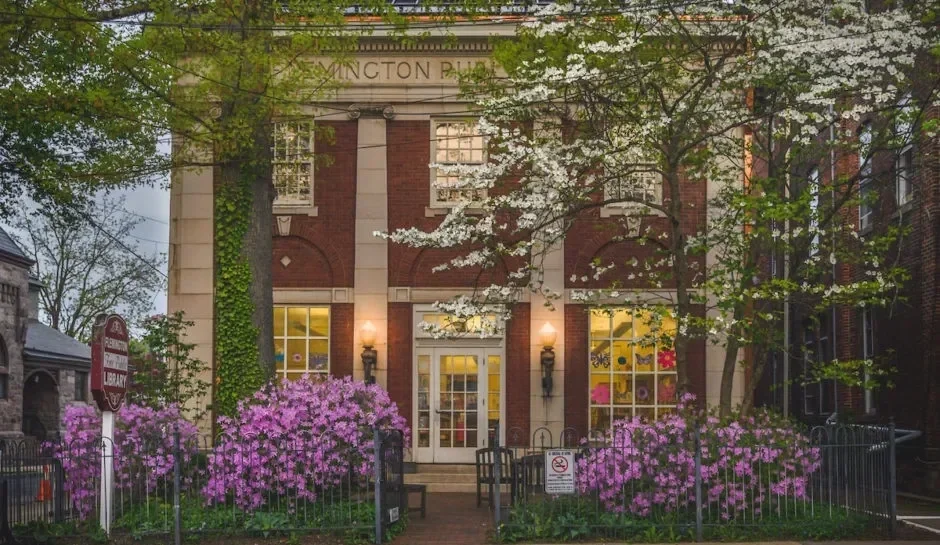
The library was built in the Renaissance Revival architectural style as evidenced by the ionic pilasters which frame the windows with keystone recessed arches as well as a dentilated cornice at the roof line. The Flemington Library building at 118 Main Street was formally dedicated in March 1911.
In 1938, the Flemington Library Association became the Free Public Library of the Borough of Flemington, when the townspeople voted to have a municipal library funded by the taxpayers. That same year, a new wing providing a reference and non-fiction section was added on the first floor, and a children’s room added on the second floor. The architecture of the addition was entirely consistent with the existing structure, such that the juncture of the structures is not readily visible.
In April of 1968, ground was broken for the Nedwill Sutphin wing, donated by Mrs. Sutphin in memory of her husband, a former treasurer of the Library’s Board of Trustees. Matching funds were contributed by Flemington Borough. The Sutphin wing, designed by Arthur C. Aalholm, housed a reading area adjacent to a fireplace, the circulation desk, library back office, and a mezzanine area above with books, study areas, and displays.
The Sutphin wing was updated in 2020 thanks to a generous bequest from the estate of Jane Kitchin. The 1960s-era wood paneling, which was deemed a hazard by the Fire Marshal, was removed, a new vestibule was constructed to better moderate infiltration of heat and cold from the Maple Avenue door, and new carpeting, railings, and a new circulation desk were installed.
In 2025, thanks to a generous bequest from the estate of Isabelle Lambelet, the library basement was renovated to provide dry storage. The library basement not only had legacy asbestos around the pipes and was too damp to store anything properly, but during the remediation project, an oil tank and fuel supply line for a long decommissioned boiler was discovered that was not removed in the late 1960s when the building's heating system was converted to natural gas. The 2025 basement remediation included lead and asbestos removal and abatement, the addition of new French drains around the basement perimeter to improve drainage, a new sump pump, new paint, new lighting, a new emergency access door to the exterior, and once the discovery was made, the removal of fuel remaining in a long-forgotten oil tank and the pipes that supplied that legacy heating system.
An article by Katherine Higgins Bamber provided many of the details on early library history.